• Space/Science
  • GeekSpeak
  • Mysteries of
    the Multiverse
  • Science Fiction
  • The Comestible Zone
  • Off-Topic
  • Community
  • Flame
  • CurrentEvents

Recent posts

Did we detect an exploding primordial black hole? RL February 7, 2026 5:29 pm (Space/Science)

Is anybody paying attention? ER February 6, 2026 4:47 pm (CurrentEvents)

Did you think there was a limit to Trump's narcissism? BuckGalaxy February 6, 2026 1:33 am (CurrentEvents)

A funny (?) interaction with chatgpt RL February 4, 2026 9:05 pm (Space/Science)

Trump Has Overwhelmed Himself BuckGalaxy February 4, 2026 3:53 pm (Flame)

FALLOUT on Amazon Prime BuckGalaxy February 3, 2026 9:33 pm (Science Fiction)

Blue Origin halts New Shepard flights BuckGalaxy January 31, 2026 3:13 am (Space/Science)

Trouble on the way BuckGalaxy January 28, 2026 1:47 pm (CurrentEvents)

Being a tech bro gets you a commission and a uniform podrock January 28, 2026 11:16 am (CurrentEvents)

Artificial Intelligence ER January 28, 2026 6:56 am (Flame)

Emily Blunt's favorite sandwich. ER January 27, 2026 7:46 am (Comestible Zone)

hey hey SDG January 26, 2026 10:38 pm (6)

Home » CurrentEvents

The Endless Summer September 5, 2024 7:44 pm ER

https://currently.att.yahoo.com/news/planet-endures-hottest-summer-record-020020237.html

2024 has broken last year’s record…for the warmest summer on record.
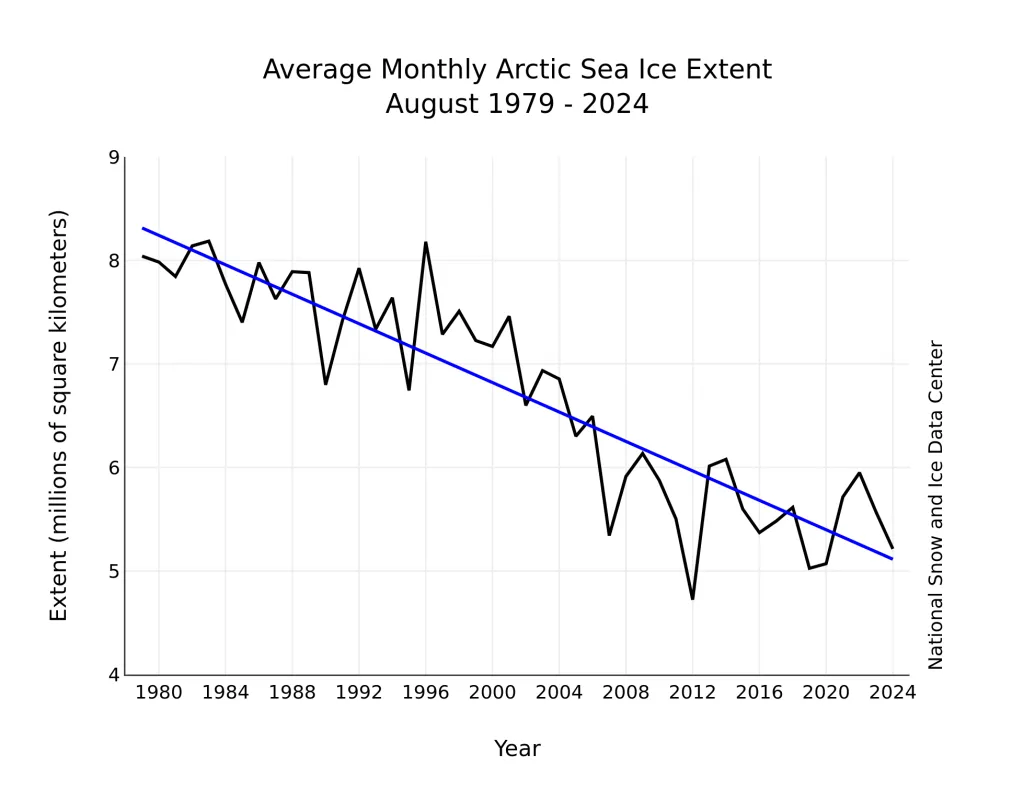
The Arctic sea ice will hit its yearly minimum in about 10 days. That graph will be posted early in October. Remember, those data points represent the average sea ice extent for the entire month. The SIE for 4 Sep 2024 is about 4.4 million km^2.

The race to the bottom
WEDNESDAY, SEPTEMBER 4, 2024
With the waning of sunlight, the pace of sea ice loss in the Arctic is slowing, and the seasonal minimum is expected in mid-September. While a new record low is highly unlikely, extent at the beginning of September is below many recent years. Both the northern and southern Northwest Passage routes have largely cleared of ice, as has the Northern Sea Route. Antarctic ice extent is approaching its seasonal maximum and is near last year’s record low.

The record lowest Arctic SIE of the satellite era (1979-present) was 3.4 million km^2 on 17 Sep 2012.

National Snow and Ice Datacenter

    Search

    The Control Panel

    • Log in
    • Register