How to See Spectacular Antares Commercial Rocket Launch to Space Station – Complete Viewing Guide
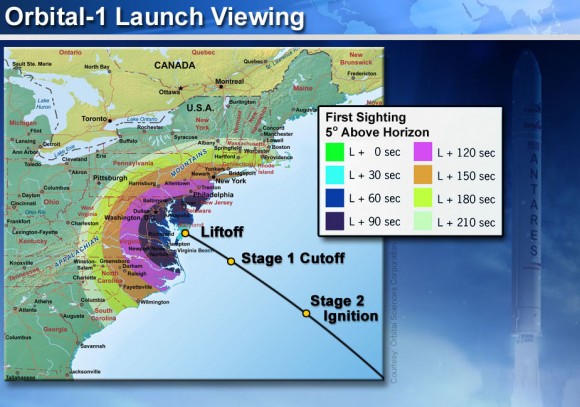
Orbital 1 Launch from NASA Wallops Island, VA on Jan. 8, 2014- Time of First Sighting Map
This map shows the rough time at which you can first expect to see Antares after it is launched on Jan. 8, 2014. It represents the time at which the rocket will reach 5 degrees above the horizon and varies depending on your location . We have selected 5 degrees as it is unlikely that you’ll be able to view the rocket when it is below 5 degrees due to buildings, vegetation, and other terrain features. As an example, using this map when observing from Washington, DC shows that Antares will reach 5 degrees above the horizon approximately 100 seconds after launch (L + 100 sec). Credit: Orbital Sciences/NASA
WALLOPS ISLAND, VA – Catching a slim weather break amidst the monster blizzard and unprecedented arctic air low temperatures afflicting the central and northern United States, Orbital Sciences Corp. is marching forward with plans for a spectacular daylight blastoff of the firms privately developed Antares rocket and Cygnus cargo spacecraft on Wednesday, Jan. 8 from a beachside pad at NASA Wallops Island, VA – on a critical mission for NASA bound for the Space Station carrying a huge cargo of vital science experiments.
The above is 1 of 9 pics made by Orbital showing viewing simulations around the East Coast.
Launch could be delayed to the 9th for warmer weather.