Our Sun is a Weirdly ‘Quiet’ Star — and that’s Lucky for All of Us
FOLLOWUP
By Meghan Bartels | Senior WriterSPACE.COM – April 30, 2020 | Thank your lucky stars that the sun is pretty weird, as scientists have learned by comparing its activity with that of similar stars.
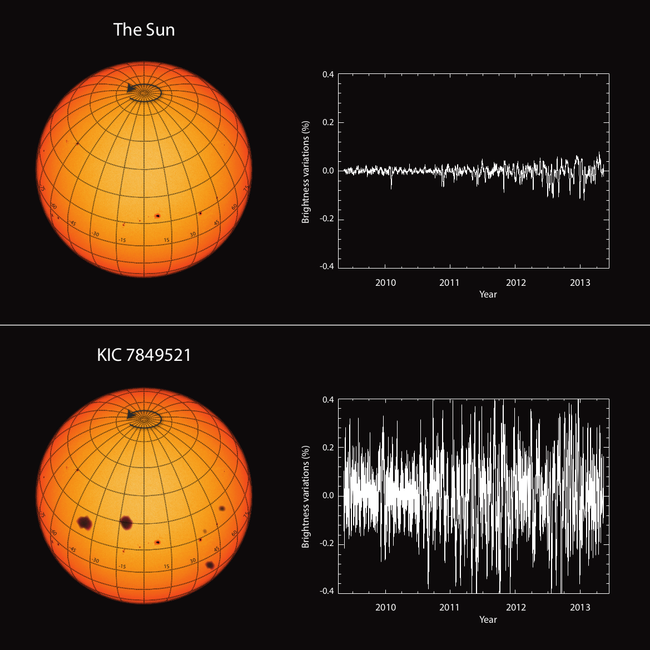
In new research, astronomers compared the brightness of our sun over time with data gathered on other stars by NASA’s Kepler Space Telescope and by the European Space Agency’s Gaia star-mapping mission. The result is a census of stars about the same size of our sun. But compared to these stars, our sun’s brightness varies significantly less, suggesting that it is calmer than other stars of about the same size.
The brightness variability of our sun compared with that of KIC 7849521, a sun-like star. (Image credit: MPS/hormesdesign.de)“We were very surprised that most of the sun-like stars are so much more active than the sun,” Alexander Shapiro, a physicist at the Max Planck Institute for Solar System Research in Germany and a co-author on the new research, said in a statement.
Scientists are well acquainted with the sun’s current behavior, of course, and have astronomical observations of dark spots on its surface going back about 400 years. Those sunspots are crucial information about the activity of the sun: They are driven by the sun’s magnetic field and massive outbursts of radiation and matter stem from them.
To understand what the sun was doing before those records begin, scientists can interpret a host of data types, like levels of specific elements in tree rings and ancient ice. With those aids, researchers have constructed estimates of the sun’s activity going back about 9,000 years. The modern sun matches that record pretty well, the researchers said — but that doesn’t mean those 9,000 years are representative of the sun’s 4.6 billion years of existence.