• Space/Science
  • GeekSpeak
  • Mysteries of
    the Multiverse
  • Science Fiction
  • The Comestible Zone
  • Off-Topic
  • Community
  • Flame
  • CurrentEvents

Recent posts

Blu-Ray ER March 15, 2026 11:27 am (Off-Topic)

Trump Administration Readies Plans to Dismantle Renowned Science Lab BuckGalaxy March 13, 2026 11:46 pm (Space/Science)

The Republic RobVG March 11, 2026 11:40 am (Off-Topic)

The Great Lie of War BuckGalaxy March 5, 2026 9:23 am (CurrentEvents)

Overheard on the internet... ER March 4, 2026 4:37 pm (CurrentEvents)

I hate waking up to war podrock February 28, 2026 11:04 am (CurrentEvents)

The religion of nonreligion can be like nonalcohol beer: What’s the point? BuckGalaxy February 28, 2026 2:25 am (Off-Topic)

MAGAlomania unleashed again BuckGalaxy February 28, 2026 2:21 am (CurrentEvents)

‘We’re Going to the Moon and Mars’ BuckGalaxy February 26, 2026 8:41 pm (Space/Science)

Is This the Most Important Supreme Court Case of the Century? BuckGalaxy February 22, 2026 8:56 pm (CurrentEvents)

Supreme Court tries to do Trump a favor BuckGalaxy February 20, 2026 10:58 am (CurrentEvents)

Role reversal ER February 20, 2026 7:58 am (Off-Topic)

Home » Space/Science

The Habitability of a Planet Depends on Many Factors . . . October 27, 2020 10:43 am DanS

Life on Earth: Why We may Have the Moon’s now Defunct Magnetic Field to Thank
This article was originally published at The Conversation. The publication contributed the article to Space.com’s Expert Voices: Op-Ed & Insights.

By Christopher Davies | Associate Professor in Theoretical Geophysics
Jon Mound | University of Leeds, Associate Professor of Geophysics, University of Leeds

OCTOBER 26, 2020 | The habitability of a planet depends on many factors. One is the existence of a strong and long-lived magnetic field. These fields are generated thousands of kilometres below the planet’s surface in its liquid core and extend far into space – shielding the atmosphere from harmful solar radiation.


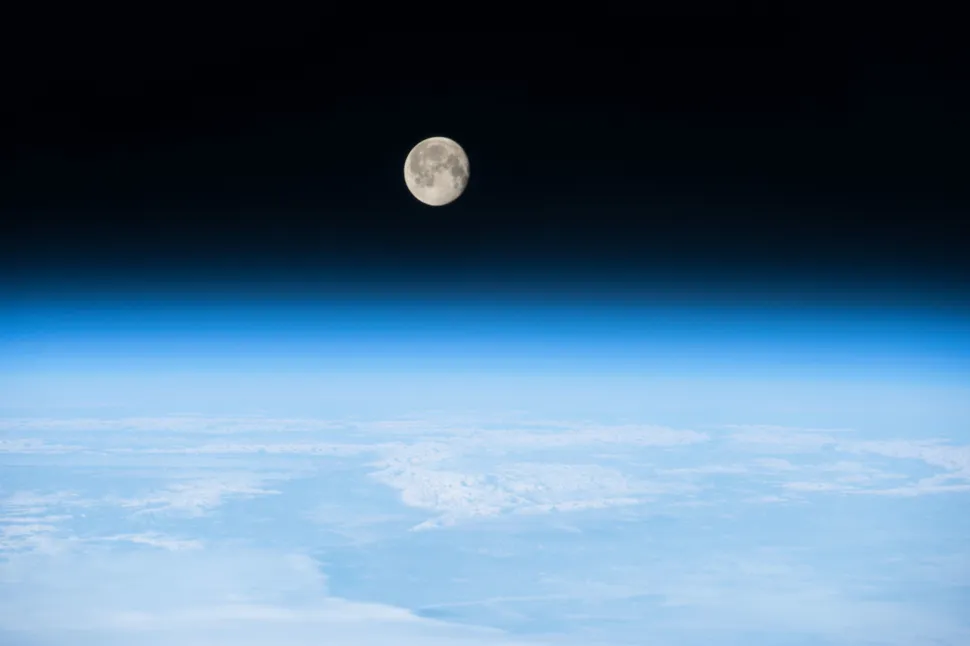
Photo of a nearly full Moon shining brightly on the Earth’s atmosphere, taken from the International Space Station.
(Image: © NASA)

Without a strong magnetic field, a planet struggles to hang on to a breathable atmosphere – which is bad news for life as we know it. A new study, published in Science Advances, suggests that the Moon’s now extinct magnetic field may have helped protect our planet’s atmosphere as life was forming around 4 billion years ago.

Today, Earth has a strong global magnetic field that protects the atmosphere and low-orbiting satellites from harsh solar radiation. In contrast, the Moon does not possess either a breathable atmosphere or a global magnetic field.
MORE:
Probing ancient magnetic fields

    Search

    The Control Panel

    • Log in
    • Register