• Space/Science
  • GeekSpeak
  • Mysteries of
    the Multiverse
  • Science Fiction
  • The Comestible Zone
  • Off-Topic
  • Community
  • Flame
  • CurrentEvents

Recent posts

Blue Origin halts New Shepard flights BuckGalaxy January 31, 2026 3:13 am (Space/Science)

Trouble on the way BuckGalaxy January 28, 2026 1:47 pm (CurrentEvents)

Being a tech bro gets you a commission and a uniform podrock January 28, 2026 11:16 am (CurrentEvents)

Artificial Intelligence ER January 28, 2026 6:56 am (Flame)

Emily Blunt's favorite sandwich. ER January 27, 2026 7:46 am (Comestible Zone)

hey hey SDG January 26, 2026 10:38 pm (6)

‘Yes, it’s going to crack’ - a spacecraft not everyone thinks is safe to fly BuckGalaxy January 23, 2026 10:42 am (Flame)

Trump’s Greenland Gambit Has Broken Brains Across Washington BuckGalaxy January 21, 2026 8:38 pm (Flame)

This is so strange, on so many levels. ER January 21, 2026 5:13 pm (Off-Topic)

What's in your wallet? ER January 19, 2026 8:10 pm (CurrentEvents)

Anne Applebaum: Trump’s Letter to Norway Should Be the Last Straw BuckGalaxy January 19, 2026 7:18 pm (Flame)

Sloppy Seconds BuckGalaxy January 16, 2026 7:24 pm (Flame)

Home » Space/Science

January Sea Ice February 7, 2023 6:30 am ER

The downward linear trend in January sea ice extent over the 44-year satellite record is 42,500 square kilometers (16,400 square miles) per year, or 3.0 percent per decade relative to the 1981 to 2010 average. Based on the linear trend, since 1979, January has lost 1.89 million square kilometers (730,000 square miles). This is equivalent to about seven times the size of Colorado or about twice the size of Germany.
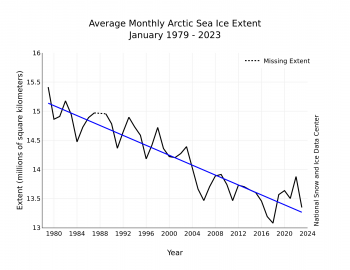
Sea Ice Extent usually hits maximum in March. But the month to watch is September, when it hits minimum, and the drop in September SIE averages 13% per decade.

But the key takeaway from all this is that no matter what month of the year you pick, the overall trend is always down.

    Search

    The Control Panel

    • Log in
    • Register