• Space/Science
  • GeekSpeak
  • Mysteries of
    the Multiverse
  • Science Fiction
  • The Comestible Zone
  • Off-Topic
  • Community
  • Flame
  • CurrentEvents

Recent posts

Trump had to be stopped from using nuclear weapons on Iran RL April 21, 2026 7:57 pm (CurrentEvents)

New Glenn 3 flight profile BuckGalaxy April 18, 2026 12:08 am (Space/Science)

NASA's Moon Base User’s Guide BuckGalaxy April 16, 2026 3:10 pm (Space/Science)

Meanwhile, bye bye National Forest Service podrock April 9, 2026 8:13 am (CurrentEvents)

Is Isreal really a US ally RobVG April 8, 2026 5:21 pm (CurrentEvents)

Eventually, one has to just admit it. podrock April 6, 2026 8:08 pm (CurrentEvents)

Where no one has gone before BuckGalaxy April 6, 2026 7:49 pm (Space/Science)

Moon noticeably getting larger in live stream RL April 6, 2026 4:23 am (Space/Science)

Regime Change BuckGalaxy April 4, 2026 4:22 pm (CurrentEvents)

HERE WE GO, BABY! BuckGalaxy April 1, 2026 3:07 pm (Space/Science)

April Fool's Day ER April 1, 2026 7:56 am (Space/Science)

A Big Beautiful Bunker podrock March 31, 2026 10:11 am (CurrentEvents)

Home » Space/Science

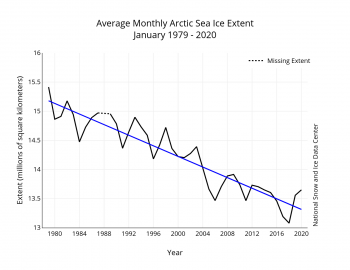
January Arctic Ice loss February 4, 2020 4:38 pm hank

https://nsidc.org/arcticseaicenews/files/1999/02/Figure3-350×270.png
.

Including 2020, the linear rate of decline for January ice extent is 3.15 percent per decade. This corresponds to a trend of 45,400 square kilometers (17,500 square miles) per year, which is roughly twice the size of the state of New Hampshire. Over the 42-year satellite record, the Arctic has lost about 1.86 million square kilometers (718,000 square miles) of ice in January, based on the difference in linear trend values in 2020 and 1979. This is an area larger than the state of Alaska.

Keep in mind this is sea ice extent, as opposed to the sea ice volume I discussed in my previous post.

    Search

    The Control Panel

    • Log in
    • Register