• Space/Science
  • GeekSpeak
  • Mysteries of
    the Multiverse
  • Science Fiction
  • The Comestible Zone
  • Off-Topic
  • Community
  • Flame
  • CurrentEvents

Recent posts

Starship V3 set to make its first launch 6:30pm ET on Monday, May 19 BuckGalaxy May 12, 2026 4:52 pm (Space/Science)

Good idea, for what it's worth... BuckGalaxy May 11, 2026 11:00 pm (CurrentEvents)

Consequences of the Orange Moron's idiotic war BuckGalaxy May 11, 2026 1:36 am (CurrentEvents)

How are you supposed to win a war when you avoid killing people RobVG May 8, 2026 5:47 pm (CurrentEvents)

There's no way the Post WW2 order can be revived after Trump BuckGalaxy April 30, 2026 5:26 pm (CurrentEvents)

Trump had to be stopped from using nuclear weapons on Iran (edit - no evidence for claim... BAD RL!) RL April 21, 2026 7:57 pm (CurrentEvents)

New Glenn 3 flight profile BuckGalaxy April 18, 2026 12:08 am (Space/Science)

NASA's Moon Base User’s Guide BuckGalaxy April 16, 2026 3:10 pm (Space/Science)

Meanwhile, bye bye National Forest Service podrock April 9, 2026 8:13 am (CurrentEvents)

Is Isreal really a US ally RobVG April 8, 2026 5:21 pm (CurrentEvents)

Eventually, one has to just admit it. podrock April 6, 2026 8:08 pm (CurrentEvents)

Home » Space/Science

old vs young sea ice October 7, 2024 5:57 am ER

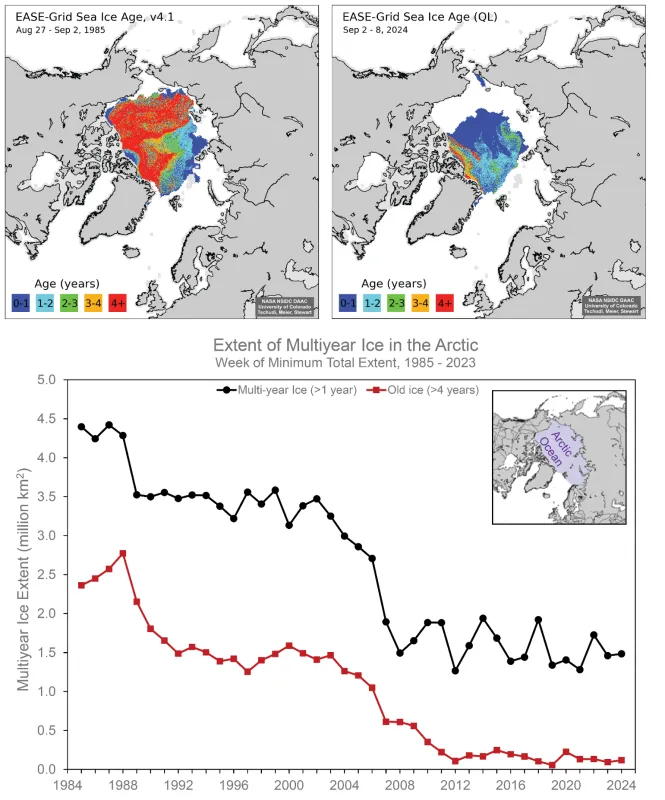
Its the upper graphic, the map comparison, that tells the story here. “Old” sea ice refers to ice that has survived more than one season, that is, it has managed to persist as sea ice through the summer melt. Old ice serves as a means of keeping the Arctic ocean waters cool and by reflecting solar radiation back into space, and to serve as a nucleus around which new ice may form as fall and winter arrive. It is also thicker, as a rule, than young ice more recently formed. It gives a measure of the volume of ice floating on the sea. In satellite imagery, it is impossible to distinguish between old and young ice, but new satellite radiometer sensors can.

In these images, the color coding indicates the age of the ice. The older ice is generally thicker, and gives a more realistic picture of the amount of ice covering the polar sea. The bottom graph tells us the old sea ice coverage has pretty much bottomed out, starting around 2008. The ice we see at the north pole now is mostly young ice, thin and low volume. Multi-year ice has pretty much leveled off at about 1.5 million km^2, while old (>4 year)sea ice coverage is now negligible.

Data from nsidc.com

    Search

    The Control Panel

    • Log in
    • Register