I’ve lost interest in the solar system. Who needs a few lumps of slag and ice, with an occasional frozen gas giant with a poisonous atmosphere thrown in? The real action is out there. Interstellar exploration is what its really all about, and now that travel thoughout our planetary system is just about routine, its time to broaden our horizons to the stars. Here’s a quick survey of the solar neighborhood.
The RASC Observer’s Handbook maintains a table of all the known stars within 5 parsecs of Sol (16.26 ly) which they keep up to date with the latest discoveries and data. Let me summarize the entries here, as listed in the 2013 edition of the Handbook and the Wikipedia entry
http://en.wikipedia.org/wiki/List_of_nearest_stars
(The two lists are not identical, this is a rapidly evolving field of study). I will use the numbers in the Handbook, you can use those from Wikipedia. I don’t know which is most current. The roster is probably not complete, many of our neighbors are very faint and there’s a good chance we haven’t found them all yet, particularly out near the edge of the 5 pc boundary, but this collection is probably as good as any you’ll find anywhere. If you consider our galaxy is 100,000 light-years across and about 2000 light years thick, this is just the start. It’s not even a proper statistical sampling of the stellar population.
Not counting Sol, there are 50 known systems inside the sphere of interest, that is, in a volume of about 524 cubic parsecs. These include 66 individual stars, 5 brown dwarfs (something between the mass of the smallest star and the biggest gas giant planet), and 7 known extrasolar planets (not counting our own sun’s companions). 16 of these systems are known multiple stars, and 5 have known planets. 49 of the 66 stars are red dwarfs, the most common but least massive true (supported by internal thermonuclear reactions) stars. Brown dwarfs glow from residual gravitational heat left over from their formation. There are 5 white dwarfs in the volume of interest. These stars are the extremely faint, tiny, incredibly dense left-over cinders of more massive stars that have evolved through their entire life cycles and are in the last stage of their lives. They will continue glowing very feebly for billions of years. Of all the stars in the list, only 10 can be seen with the naked eye. Most of those thousands of stars you see at night are extremely bright, but very far away. The bulk of the stars are intrinsically faint, the night sky only shows us the few really bright ones. Most of the stars, even those very close to us, are invisible to the unaided eye.
Our own sun is brighter than most stars, but is nowhere near as bright as the very brightest stars. If Sol were 5 parsecs away, at the edge of the sphere of interest, it would appear to be magnitude 3.32. Easily visible to the naked eye, but not a bright star by any means. It would simply be lost on a clear night, unless you knew exactly where to look.
Those of you interested in the Solar Neighborhood might be interested in the Gliese Catalog of Nearby Stars, which lists about 3800 stars knownto be within 25 parsecs. The Catalog is definitely not complete. Intrinsically faint stars, especially at higher distances, are likely to be left out. The online Catalog is sortable by distance, apparent brightness, and intrinsic brightness.
http://migall.fastmail.fm/astronomy/stars_and_nebulae/CNS3/CNS3_distance.htm
***
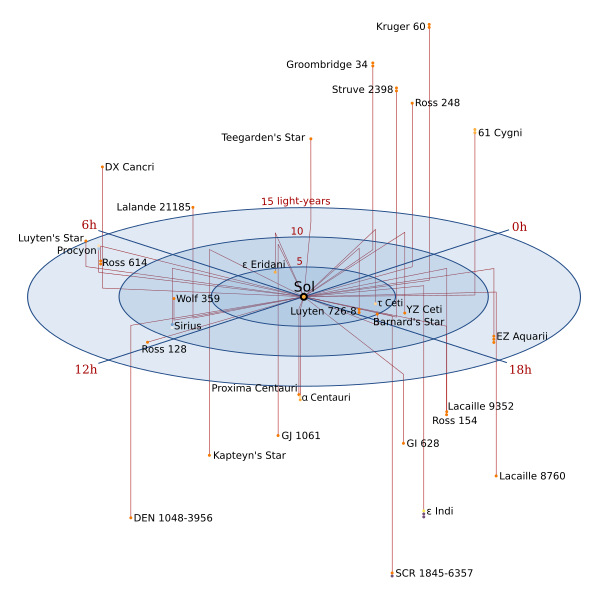
- I think we have the nicest place in town.