http://www.jpl.nasa.gov/spaceimages/images/mediumsize/PIA20355_ip.jpg
http://www.jpl.nasa.gov/spaceimages/details.php?id=PIA20355
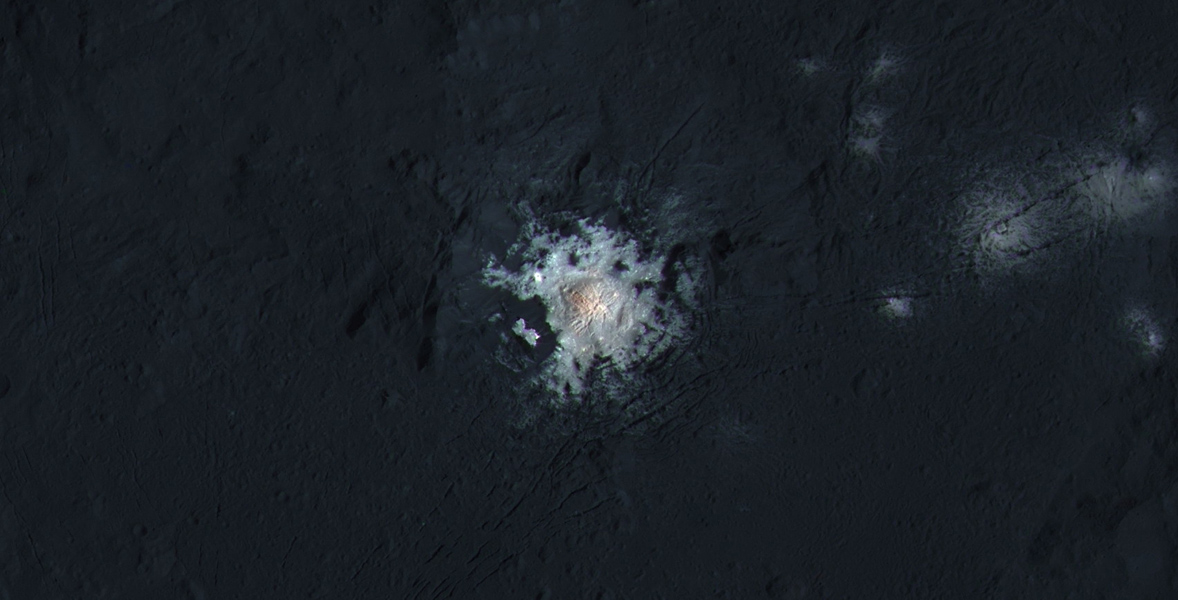
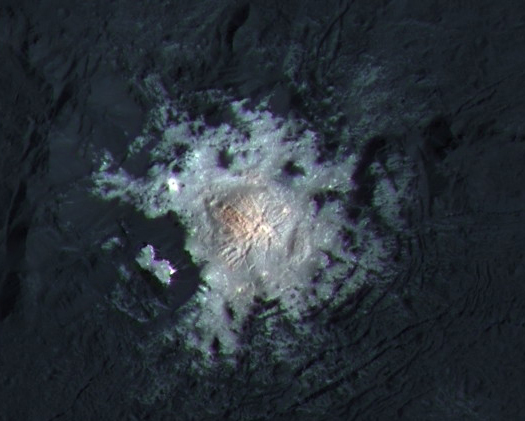
The bright central spots near the center of Occator Crater are shown in enhanced color in this view from NASA’s Dawn spacecraft. Such views can be used to highlight subtle color differences on Ceres’ surface.
Lower resolution color data have been overlaid onto a higher resolution view (see PIA20350) of the crater.
The view was produced by combining the highest resolution images of Occator obtained in February 2016 (at image scales of 35 meters, or 115 feet, per pixel) with color images obtained in September 2015 (at image scales of 135 meters, or about 440 feet, per pixel). The three images used to produce the color were taken using spectral filters centered at 438, 550 and 965 nanometers (the latter being slightly beyond the range of human vision, in the near-infrared).
The crater measures 57 miles (92 kilometers) across and 2.5 miles (4 kilometers) deep. Dawn’s close-up view reveals a dome in a smooth-walled pit in the bright center of the crater. Numerous linear features and fractures crisscross the top and flanks of this dome.
Dawn’s mission is managed by JPL for NASA’s Science Mission Directorate in Washington. Dawn is a project of the directorate’s Discovery Program, managed by NASA’s Marshall Space Flight Center in Huntsville, Alabama. UCLA is responsible for overall Dawn mission science. Orbital ATK, Inc., in Dulles, Virginia, designed and built the spacecraft. The German Aerospace Center, the Max Planck Institute for Solar System Research, the Italian Space Agency and the Italian National Astrophysical Institute are international partners on the mission team. For a complete list of acknowledgments, see http://dawn.jpl.nasa.gov/mission.
For more information about the Dawn mission, visit http://dawn.jpl.nasa.gov.
UPDATE: Zoomed:
-
Observations
-
It's a gift
-
We're so fortunate to have a geologist on the payroll!
-
We really should double his pay...
-
At the very least he should get a key to the executive washroom.
-
At the very least he should get a key to the executive washroom.
-
We really should double his pay...
-
It's a gift
-
Sweet!! Yet again, NASA delivers.