• Space/Science
  • GeekSpeak
  • Mysteries of
    the Multiverse
  • Science Fiction
  • The Comestible Zone
  • Off-Topic
  • Community
  • Flame
  • CurrentEvents

Recent posts

Trump's impulsive, ill-advised war has screwed the world BuckGalaxy May 19, 2026 1:46 pm (CurrentEvents)

Blue Origin's Blue Ring Asteroid Prospectors BuckGalaxy May 19, 2026 12:19 pm (Space/Science)

Europe unveils the RLV C5, a partially reusable rocket designed to rival SpaceX Starship BuckGalaxy May 19, 2026 2:06 am (Space/Science)

Dividing up the World RobVG May 15, 2026 12:56 pm (CurrentEvents)

Foundation RobVG May 15, 2026 11:56 am (Science Fiction)

Przybylski’s Star: Still Bizarre After All These Years ER May 15, 2026 8:09 am (Space/Science)

Starship V3 set to make its first launch 6:30pm ET on Monday, May 19 BuckGalaxy May 12, 2026 4:52 pm (Space/Science)

Good idea, for what it's worth... BuckGalaxy May 11, 2026 11:00 pm (CurrentEvents)

Consequences of the Orange Moron's idiotic war BuckGalaxy May 11, 2026 1:36 am (CurrentEvents)

How are you supposed to win a war when you avoid killing people RobVG May 8, 2026 5:47 pm (CurrentEvents)

There's no way the Post WW2 order can be revived after Trump BuckGalaxy April 30, 2026 5:26 pm (CurrentEvents)

Home » Space/Science

Cosmologists Create 4,000 Virtual Universes to Solve Big Bang Mystery . . . February 24, 2021 1:10 pm DanS

Cosmologists Create 4,000 Virtual Universes to Solve Big Bang Mystery
A supercomputer presses the rewind button on the universe’s creation.

By Stephanie Pappas | Live Science Contributor

February 22, 2021 | Cosmologists are pressing rewind on the first instant after the Big Bang by simulating 4,000 versions of the universe on a massive supercomputer.


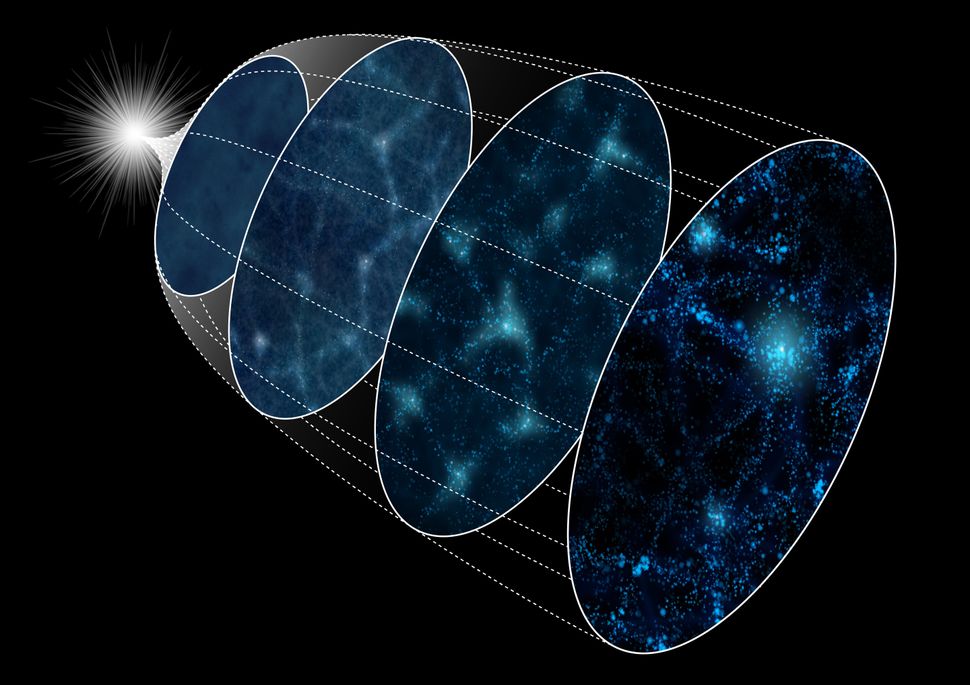
Diagram of the evolution of the universe from the inflation (left) to the present (right). The reconstruction method winds back the evolution from right to left on this illustration to reproduce the primordial density fluctuations from the current galaxy distribution. (Image credit: The Institute of Statistical Mathematics)

The goal is to paint a picture of the immediate aftermath of the Big Bang, when the observable universe suddenly expanded 1 trillion trillion times in size in the tiniest sliver of a microsecond. By applying the method used for the simulations to real observations of today’s universe, researchers hope to arrive at an accurate understanding of what this inflationary period looked like.

“We are trying to do something like guessing a baby photo of our universe from the latest picture,” study leader Masato Shirasaki, a cosmologist at the National Astronomical Observatory of Japan (NAOJ), wrote in an email to Live Science.
More:
Patchy universe

    Search

    The Control Panel

    • Log in
    • Register