• Space/Science
  • GeekSpeak
  • Mysteries of
    the Multiverse
  • Science Fiction
  • The Comestible Zone
  • Off-Topic
  • Community
  • Flame
  • CurrentEvents

Recent posts

50 sites BuckGalaxy June 10, 2026 9:19 pm (Off-Topic)

1700 free online university courses BuckGalaxy June 10, 2026 8:58 pm (Off-Topic)

Sigh. podrock June 10, 2026 12:29 pm (CurrentEvents)

The Platner Disaster, plus... BuckGalaxy June 9, 2026 1:43 pm (Flame)

Starfall BuckGalaxy June 2, 2026 6:30 pm (Space/Science)

It keeps getting worse... BuckGalaxy June 2, 2026 3:11 pm (Flame)

Starship Troopers on the Moon BuckGalaxy June 2, 2026 2:51 pm (Space/Science)

Musk wants self-sustaining space colonies BuckGalaxy May 31, 2026 6:11 pm (Space/Science)

Federal judge reopens Trump’s IRS case and demands to know if her court was defrauded. BuckGalaxy May 29, 2026 10:38 pm (Flame)

Ukraine winning the war BuckGalaxy May 29, 2026 11:14 am (CurrentEvents)

New Glenn explodes in big setback for Blue Origin BuckGalaxy May 28, 2026 7:54 pm (Space/Science)

Firefly set to visit Gruithuisen Domes BuckGalaxy May 28, 2026 4:32 pm (Space/Science)

Home » Space/Science

Cosmologists Create 4,000 Virtual Universes to Solve Big Bang Mystery . . . February 24, 2021 1:10 pm DanS

Cosmologists Create 4,000 Virtual Universes to Solve Big Bang Mystery
A supercomputer presses the rewind button on the universe’s creation.

By Stephanie Pappas | Live Science Contributor

February 22, 2021 | Cosmologists are pressing rewind on the first instant after the Big Bang by simulating 4,000 versions of the universe on a massive supercomputer.


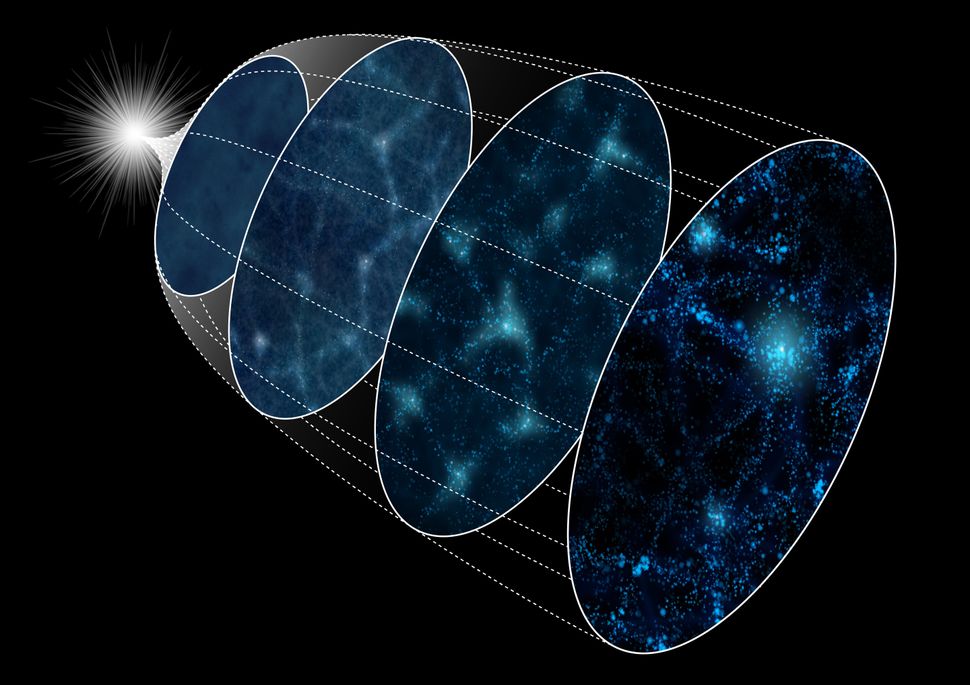
Diagram of the evolution of the universe from the inflation (left) to the present (right). The reconstruction method winds back the evolution from right to left on this illustration to reproduce the primordial density fluctuations from the current galaxy distribution. (Image credit: The Institute of Statistical Mathematics)

The goal is to paint a picture of the immediate aftermath of the Big Bang, when the observable universe suddenly expanded 1 trillion trillion times in size in the tiniest sliver of a microsecond. By applying the method used for the simulations to real observations of today’s universe, researchers hope to arrive at an accurate understanding of what this inflationary period looked like.

“We are trying to do something like guessing a baby photo of our universe from the latest picture,” study leader Masato Shirasaki, a cosmologist at the National Astronomical Observatory of Japan (NAOJ), wrote in an email to Live Science.
More:
Patchy universe

    Search

    The Control Panel

    • Log in
    • Register