• Space/Science
  • GeekSpeak
  • Mysteries of
    the Multiverse
  • Science Fiction
  • The Comestible Zone
  • Off-Topic
  • Community
  • Flame
  • CurrentEvents

Recent posts

Starfall BuckGalaxy June 2, 2026 6:30 pm (Space/Science)

It keeps getting worse... BuckGalaxy June 2, 2026 3:11 pm (Flame)

Starship Troopers on the Moon BuckGalaxy June 2, 2026 2:51 pm (Space/Science)

Musk wants self-sustaining space colonies BuckGalaxy May 31, 2026 6:11 pm (Space/Science)

Federal judge reopens Trump’s IRS case and demands to know if her court was defrauded. BuckGalaxy May 29, 2026 10:38 pm (Flame)

Ukraine winning the war BuckGalaxy May 29, 2026 11:14 am (CurrentEvents)

New Glenn explodes in big setback for Blue Origin BuckGalaxy May 28, 2026 7:54 pm (Space/Science)

Firefly set to visit Gruithuisen Domes BuckGalaxy May 28, 2026 4:32 pm (Space/Science)

Trump threatens another ally BuckGalaxy May 27, 2026 5:56 pm (CurrentEvents)

NASA Scientists Discover Material That Could Protect Jet Engines And Moon Equipment BuckGalaxy May 25, 2026 12:36 pm (Space/Science)

SEASON 5 - FOR ALL MANKIND BuckGalaxy May 24, 2026 11:28 pm (Science Fiction)

Trump's impulsive, ill-advised war has screwed the world BuckGalaxy May 19, 2026 1:46 pm (CurrentEvents)

Home » Space/Science

And of course, fossil fuel CO2 has nothing to do with it. December 7, 2016 6:56 pm hank

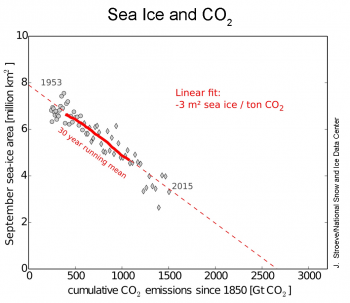
A new study published in the journal Science links Arctic sea ice loss to cumulative CO2 emissions in the atmosphere through a simple linear relationship (Figure 6). Researchers conducting the study, including NSIDC scientist Julienne Stroeve, examined this linear relationship based on observations from the satellite and pre-satellite era since 1953, and in climate models. The observed relationship is equivalent to a loss of 3 square meters (9.9 square feet) for every metric ton of CO2 added to the atmosphere, compared the average from all the climate models of 1.75 square meters (5.8 square feet). This smaller value, or lower sensitivity, from the models is consistent with findings that the models tend to be generally conservative relative to observations in regard to how fast the Arctic has been losing its summer ice cover.

http://nsidc.org/arcticseaicenews/files/1999/12/Figure5-350×303.png
.

Figure 6. This plot shows the relationship between September sea ice extent (1953 to 2015) and cumulative CO2 emissions since 1850. Grey diamonds represent the individual satellite data values; circles represent pre-satellite era values; the solid red line shows the 30-year running average. The dotted red line indicates the linear relationship of 3 square meters per metric ton of CO2.

Credit: J. Stroeve, National Snow and Ice Data Center High-resolution image

    Search

    The Control Panel

    • Log in
    • Register