• Space/Science
  • GeekSpeak
  • Mysteries of
    the Multiverse
  • Science Fiction
  • The Comestible Zone
  • Off-Topic
  • Community
  • Flame
  • CurrentEvents

Recent posts

Trump had to be stopped from using nuclear weapons on Iran RL April 21, 2026 7:57 pm (CurrentEvents)

New Glenn 3 flight profile BuckGalaxy April 18, 2026 12:08 am (Space/Science)

NASA's Moon Base User’s Guide BuckGalaxy April 16, 2026 3:10 pm (Space/Science)

Meanwhile, bye bye National Forest Service podrock April 9, 2026 8:13 am (CurrentEvents)

Is Isreal really a US ally RobVG April 8, 2026 5:21 pm (CurrentEvents)

Eventually, one has to just admit it. podrock April 6, 2026 8:08 pm (CurrentEvents)

Where no one has gone before BuckGalaxy April 6, 2026 7:49 pm (Space/Science)

Moon noticeably getting larger in live stream RL April 6, 2026 4:23 am (Space/Science)

Regime Change BuckGalaxy April 4, 2026 4:22 pm (CurrentEvents)

HERE WE GO, BABY! BuckGalaxy April 1, 2026 3:07 pm (Space/Science)

April Fool's Day ER April 1, 2026 7:56 am (Space/Science)

A Big Beautiful Bunker podrock March 31, 2026 10:11 am (CurrentEvents)

Home » Space/Science

The December, 2016 numbers January 5, 2017 1:50 pm hank

From the National Snow and Ice Data Center (NSIDC)

Sea ice in the Arctic and the Antarctic set record low extents every day in December, continuing the pattern that began in November. Warm atmospheric conditions persisted over the Arctic Ocean, notably in the far northern Atlantic and the northern Bering Sea. Air temperatures near the Antarctic sea ice edge were near average. For the year 2016, sea ice extent in both polar regions was at levels well below what is typical of the past several decades.
…
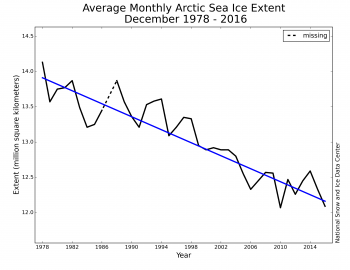
Arctic sea ice extent for December 2016 averaged 12.10 million square kilometers (4.67 million square miles), the second lowest December extent in the satellite record. This is 20,000 square kilometers (7,700 square miles) above December 2010, the lowest December extent, and 1.03 million square kilometers (397,700 square miles) below the December 1981 to 2010 long-term average.
…
Through 2016, the linear rate of decline for December is 44,500 square kilometers (17,200 square miles) per year, or 3.4 percent per decade.

http://nsidc.org/arcticseaicenews/files/2017/01/Figure3-350×270.png
.

  • Thanks for posting this, hank by mcfly 2017-01-06 08:57:15
    • Thank YOU! It's nice to know someone else is paying attention. by hank 2017-01-06 10:00:36

    Search

    The Control Panel

    • Log in
    • Register