• Space/Science
  • GeekSpeak
  • Mysteries of
    the Multiverse
  • Science Fiction
  • The Comestible Zone
  • Off-Topic
  • Community
  • Flame
  • CurrentEvents

Recent posts

Trump's impulsive, ill-advised war has screwed the world BuckGalaxy May 19, 2026 1:46 pm (CurrentEvents)

Blue Origin's Blue Ring Asteroid Prospectors BuckGalaxy May 19, 2026 12:19 pm (Space/Science)

Europe unveils the RLV C5, a partially reusable rocket designed to rival SpaceX Starship BuckGalaxy May 19, 2026 2:06 am (Space/Science)

Dividing up the World RobVG May 15, 2026 12:56 pm (CurrentEvents)

Foundation RobVG May 15, 2026 11:56 am (Science Fiction)

Przybylski’s Star: Still Bizarre After All These Years ER May 15, 2026 8:09 am (Space/Science)

Starship V3 set to make its first launch 6:30pm ET on Monday, May 19 BuckGalaxy May 12, 2026 4:52 pm (Space/Science)

Good idea, for what it's worth... BuckGalaxy May 11, 2026 11:00 pm (CurrentEvents)

Consequences of the Orange Moron's idiotic war BuckGalaxy May 11, 2026 1:36 am (CurrentEvents)

How are you supposed to win a war when you avoid killing people RobVG May 8, 2026 5:47 pm (CurrentEvents)

There's no way the Post WW2 order can be revived after Trump BuckGalaxy April 30, 2026 5:26 pm (CurrentEvents)

Home » Space/Science

Life in the crystal cave... inside the crystals... February 18, 2017 4:24 pm RL


http://www.bbc.com/news/science-environment-39013829

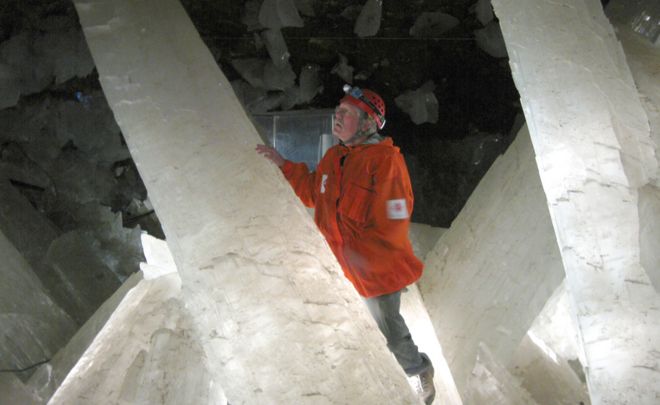
Scientists have extracted long-dormant microbes from inside the famous giant crystals of the Naica mountain caves in Mexico – and revived them.
The organisms were likely to have been encased in the striking shafts of gypsum at least 10,000 years ago, and possibly up to 50,000 years ago.
It is another demonstration of the ability of life to adapt and cope in the most hostile of environments.
“Other people have made longer-term claims for the antiquity of organisms that were still alive, but in this case these organisms are all very extraordinary – they are not very closely related to anything in the known genetic databases,” said Dr Penelope Boston.
The new director of Nasa’s Astrobiology Institute in Moffett Field, California, described her findings here at the annual meeting of the American Association for the Advancement of Science (AAAS).

…
The environment is hot (40-60C), humid and acidic. With no light at depth, any lifeform must chemosynthesise to survive. That is, it must derive the energy needed to sustain itself by processing rock minerals.
Researchers had identified microbes living in the walls of the caves, but isolating them from inside the metres-long crystals is a surprise.
These outsized needles of gypsum have grown over millions of years. They are not perfect. In places they have defects – small voids where fluids have collected and become encased.

  • I saw a TV special on that place once. by hank 2017-02-18 16:50:57

    Search

    The Control Panel

    • Log in
    • Register