• Space/Science
  • GeekSpeak
  • Mysteries of
    the Multiverse
  • Science Fiction
  • The Comestible Zone
  • Off-Topic
  • Community
  • Flame
  • CurrentEvents

Recent posts

Starfall BuckGalaxy June 2, 2026 6:30 pm (Space/Science)

It keeps getting worse... BuckGalaxy June 2, 2026 3:11 pm (Flame)

Starship Troopers on the Moon BuckGalaxy June 2, 2026 2:51 pm (Space/Science)

Musk wants self-sustaining space colonies BuckGalaxy May 31, 2026 6:11 pm (Space/Science)

Federal judge reopens Trump’s IRS case and demands to know if her court was defrauded. BuckGalaxy May 29, 2026 10:38 pm (Flame)

Ukraine winning the war BuckGalaxy May 29, 2026 11:14 am (CurrentEvents)

New Glenn explodes in big setback for Blue Origin BuckGalaxy May 28, 2026 7:54 pm (Space/Science)

Firefly set to visit Gruithuisen Domes BuckGalaxy May 28, 2026 4:32 pm (Space/Science)

Trump threatens another ally BuckGalaxy May 27, 2026 5:56 pm (CurrentEvents)

NASA Scientists Discover Material That Could Protect Jet Engines And Moon Equipment BuckGalaxy May 25, 2026 12:36 pm (Space/Science)

SEASON 5 - FOR ALL MANKIND BuckGalaxy May 24, 2026 11:28 pm (Science Fiction)

Trump's impulsive, ill-advised war has screwed the world BuckGalaxy May 19, 2026 1:46 pm (CurrentEvents)

Home » Space/Science

Measuring Marine Mean March Melt Maxes April 7, 2018 5:02 am hank

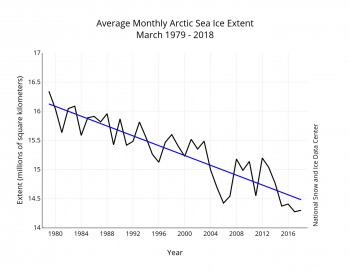
March is when the ice is at its maximum, the sun is just starting to move N of the equator and things are finally starting to warm up after a long, cold, dark winter. Each data point on the series represents the average sea ice extent for the entire month, so it is relatively buffered from local or short term meteorological events.

Consequently, changes in the Arctic are least noticeable in Spring, and year-long trends are least obvious. The graph below displays all the sea ice in the Arctic Basin in all the Marches since the satellites have been gathering data. I dread to think what this graph will look like in September, when the melt will be amplified by the long days of the Midnight Sun.

http://nsidc.org/arcticseaicenews/files/2018/04/Figure3-350×270.png
.

The linear rate of decline for March ice extent is 42,200 square kilometers (16,400 square miles) per year, or 2.7 percent per decade relative to the 1981 to 2010 average.

  • Clever climate contrarians could crazily claim: "Maybe Maunder Maximums might make meager March melt maximums" by RL 2018-04-07 18:56:56
    • Thanks, I needed that. by hank 2018-04-07 20:20:50
    • Arctic monthly air temp rankings by hank 2018-04-07 05:31:34

      Search

      The Control Panel

      • Log in
      • Register