• Space/Science
  • GeekSpeak
  • Mysteries of
    the Multiverse
  • Science Fiction
  • The Comestible Zone
  • Off-Topic
  • Community
  • Flame
  • CurrentEvents

Recent posts

Rant about anti-Israel hate BuckGalaxy June 13, 2026 2:45 pm (Flame)

I saw "Disclosure Day" today. ER June 12, 2026 8:00 pm (Science Fiction)

50 sites BuckGalaxy June 10, 2026 9:19 pm (Off-Topic)

1700 free online university courses BuckGalaxy June 10, 2026 8:58 pm (Off-Topic)

Sigh. podrock June 10, 2026 12:29 pm (CurrentEvents)

The Platner Disaster, plus... BuckGalaxy June 9, 2026 1:43 pm (Flame)

Starfall BuckGalaxy June 2, 2026 6:30 pm (Space/Science)

It keeps getting worse... BuckGalaxy June 2, 2026 3:11 pm (Flame)

Starship Troopers on the Moon BuckGalaxy June 2, 2026 2:51 pm (Space/Science)

Musk wants self-sustaining space colonies BuckGalaxy May 31, 2026 6:11 pm (Space/Science)

Federal judge reopens Trump’s IRS case and demands to know if her court was defrauded. BuckGalaxy May 29, 2026 10:38 pm (Flame)

Ukraine winning the war BuckGalaxy May 29, 2026 11:14 am (CurrentEvents)

Home » Space/Science

Rugby ... i-i-in ... Spa-a-ace . . . April 6, 2020 1:06 pm DanS

Heavy-Metal Alien Planet May be Shaped Like a Football

By Charles Q. Choi

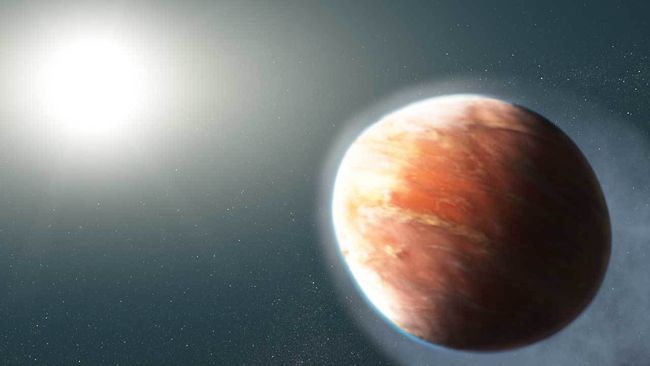
An exoplanet may be shaped like an American football due to the mighty gravitational forces it experiences close to its star, a new study finds.

Scientists investigated KOI 1843.03, an exoplanet candidate that scientists need further observations to say for sure is real. This world putatively orbits a red dwarf star with slightly less than half the mass of our sun and is located about 395 light-years from Earth. Previous research found KOI 1843.03 was about 44% Earth’s mass and 60% Earth’s diameter.


An artist’s depiction of a distorted exoplanet.
(Image: © NASA, ESA, and J. Olmsted (STScI))

Prior work suggested KOI 1843.03 orbited its star more closely than any other planet known yet. “Whizzing around its star in only 4.245 hours, a ‘year’ for this planet is just over one-sixth of a day on Earth,” Leslie Rogers, an astrophysicist at the University of Chicago and the senior author of the new research, told Space.com.
    Search

    The Control Panel

    • Log in
    • Register