NASA’s Plan to Turn the Moon Into a Telescope Looks Like the Death Star
A newly funded concept envisions a kilometre-wide radio telescope built inside a crater on the far side of the Moon. Whoa.
By Becky Ferreira | Tech-Science WriterThis article originally appeared on VICE US. VICE MEDIA, LLC – April 14, 2020 | The far side of the Moon is a land of quiet mystery. Because it always faces away from Earth, all the noisy radio transmissions that we humans blast out never reach this part of the Moon.
Scientists have dreamed of capitalizing on this unique radio silence for decades, and NASA has now brought that vision one step closer to reality by funding a proposal to build a radio telescope inside a crater on the far side of the Moon.
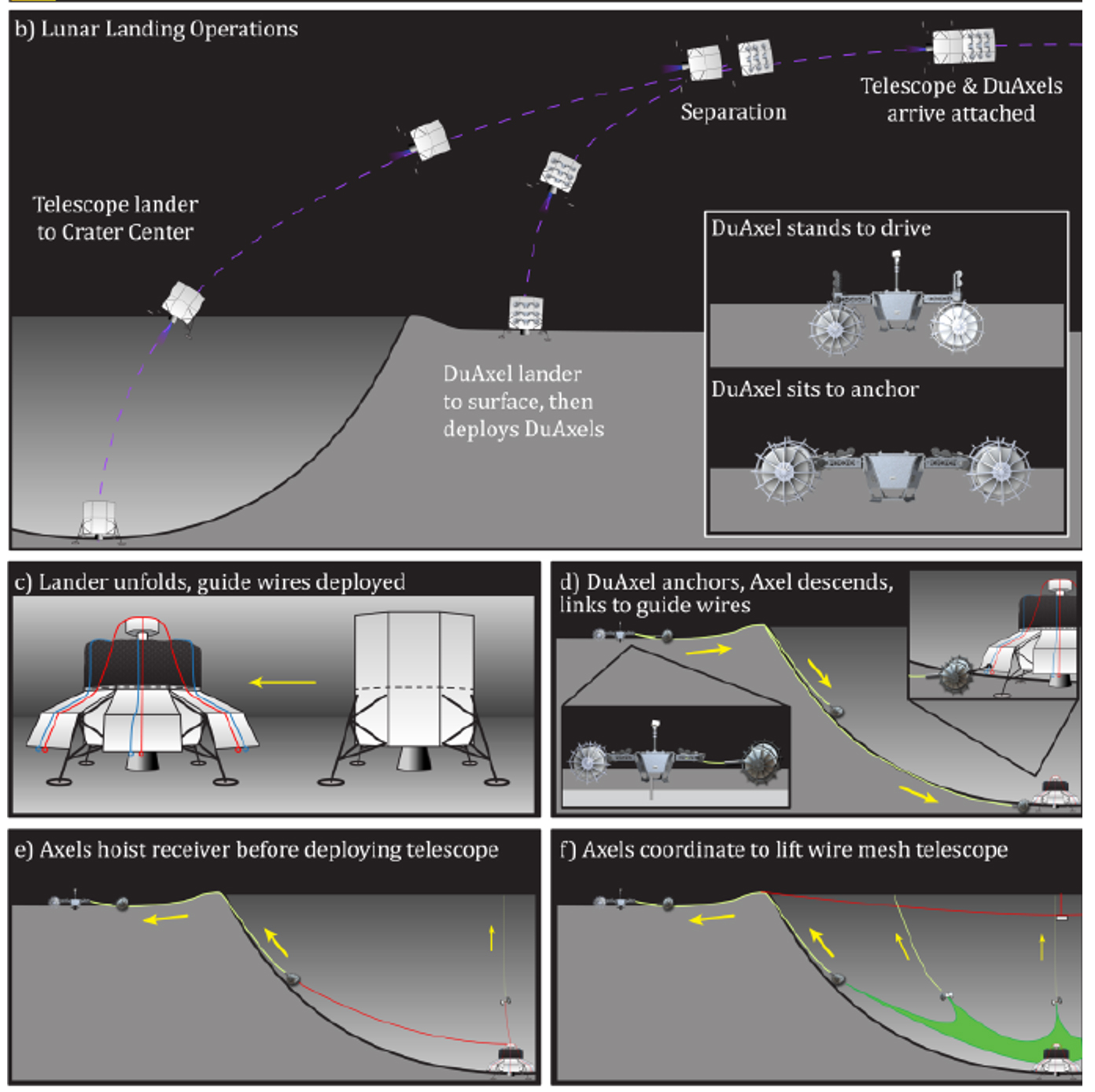
Concept of operations for building LCRT. Image: Saptarshi BandyopadhyayThe proposed observatory would be one kilometer in diameter, making it “the largest filled-aperture radio telescope in the solar system,” according to a NASA abstract about the concept.
Called the Lunar Crater Radio Telescope (LCRT), the proposal is the brainchild of Saptarshi Bandyopadhyay, a robotics technologist at NASA’s Jet Propulsion Laboratory. On Tuesday, LCRT was selected for initial “Phase 1” funding ($125,000) by NASA Innovative Advanced Concepts (NIAC) program, which aims to explore advanced, far-future technologies.
Sure hope it’ll be ready for that day’s-long, hot exposure to pure solar emissions.