Scientists Think They’ve Detected Radio Emissions from an Alien World
Similar findings may tell scientists about magnetic fields around exoplanets.
By Meghan Bartels | SPACE.com Senior WriterDecember 17, 2020 | Scientists may have detected radio emissions from a planet orbiting a star beyond our sun for the first time.
The astronomers behind the new research used a radio telescope in the Netherlands to study three different stars known to host exoplanets. The researchers compared what they saw to observations of Jupiter, diluted as if being seen from a star system dozens of light-years away. And one star system stood out: Tau Boötes, which contains at least one exoplanet. If the detection holds up, it could open the door to better understanding the magnetic fields of exoplanets and therefore the exoplanets themselves, the researchers hope.
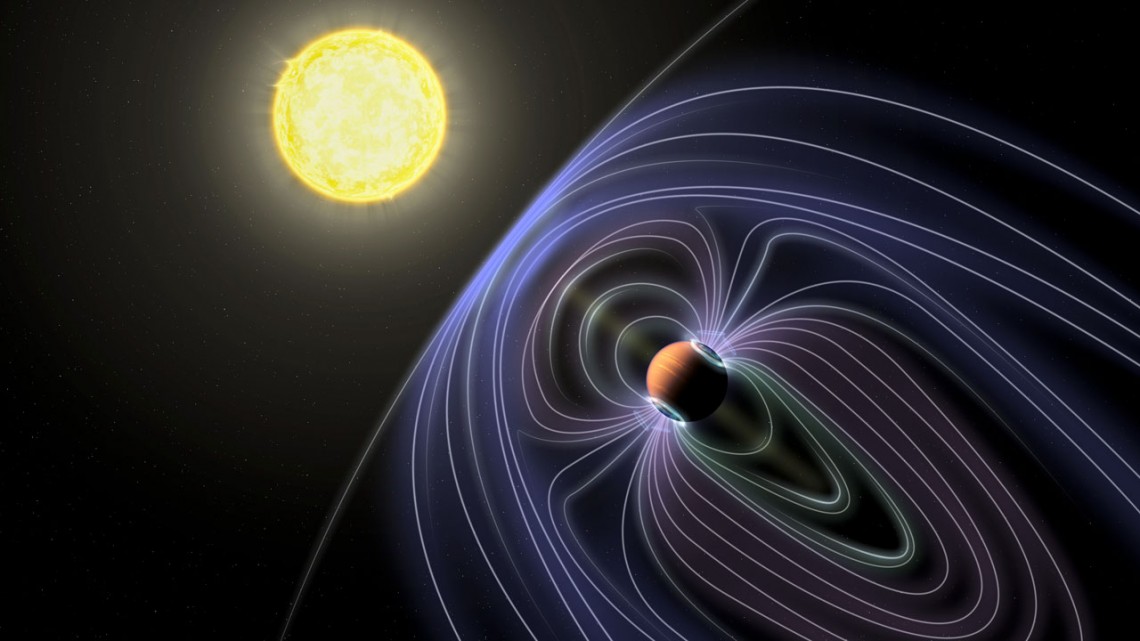
In this artistic rendering of the Tau Boötes b system, the lines representing the invisible magnetic field are shown protecting the hot Jupiter planet from solar wind. (Image credit: Jack Madden/Cornell University)“We present one of the first hints of detecting an exoplanet in the radio realm,” Jake Turner, an astronomer at Cornell University and lead author of the new research, said in a statement. “We make the case for an emission by the planet itself. From the strength and polarization of the radio signal and the planet’s magnetic field, it is compatible with theoretical predictions.”
However, Turner and his colleagues aren’t yet positive that the signal they detected really is coming from the planet, dubbed Tau Boötes b; the researchers called for additional observations of the system, which is about 51 light-years away from Earth in the constellation Boötes.
The new research actually began at Jupiter; the researchers had previously studied that planet’s radio emissions and then tweaked those measurements to reflect the effect they expected closeness to the host star and distance from Earth would have had on their observations of an exoplanet.