Defending Earth Against Dangerous Asteroids: Q&A with NASA’s Lindley Johnson
A major asteroid or comet strike could cause extensive devastation and profoundly affect life on Earth.
By Leonard DavidJanuary 6, 2021 | It’s a cosmic roll of the dice. There’s no doubt that a major asteroid or comet strike could cause extensive devastation and profoundly affect life on Earth.
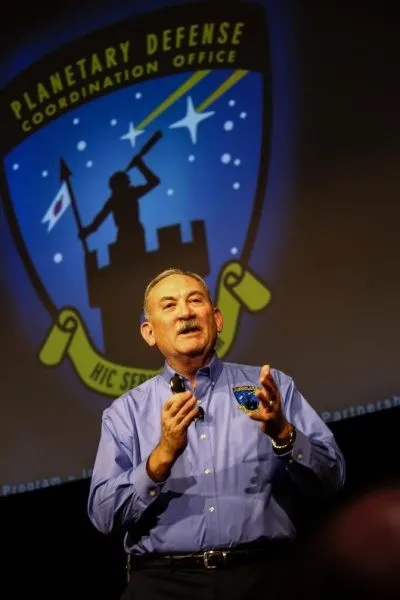
Lindley Johnson, NASA’s Planetary Defense Officer and program executive of the Planetary Defense Coordination Office.
(Image: © Lonnie Anderson/Sandia National Laboratories)The largest hit in recent times was the object that exploded over Tunguska, Siberia, in June 1908 with an energy impact of five to 15 megatons. Then there was that spectacular and destructive airburst in February 2013 over the Russian city of Chelyabinsk. The Chelyabinsk explosion generated a shock wave that shattered windows on the ground, and the resulting flying glass shards injured more than 1,000 people.
While these run-ins are few and far between, those in the know call them wakeup calls.
Thwarting an incoming object that has Earth in its crosshairs will mean deflecting or disrupting the hazardous object. That’s a task of planetary defense, an “applied planetary science” to address the near-Earth object (NEO) impact hazard.
Lindley Johnson is NASA’s Planetary Defense Officer and program executive of the Planetary Defense Coordination Office. An email from him includes the on-the-job line: “Hic Servare Diem,” Latin for “Here to Save the Day.”