http://www.cnn.com/2015/03/07/travel/warm-winter-iditarod-feat/
While cities across the northeastern United States have seen record snowfall this winter, Alaska received less snow than usual. Anchorage collected only 20 inches of snow this season, compared with a seasonal average of 60 inches.
Race organizers made the unanimous decision in February to move the race after determining that conditions were worse than last year in critical areas, and “therefore not safe enough for the upcoming race,”
…
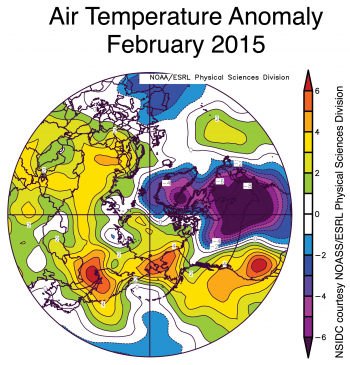
The lack of snow could be attributed to a highly amplified jet stream that brought warm air from the Pacific to the region, said meteorologist Dave Snider with the National Weather Service in Anchorage.“It’s the same weather pattern that brought the east coast such snowy and cold weather this season. Alaska was simply on the warmer side of this weather pattern,” he said.
http://nsidc.org/arcticseaicenews/
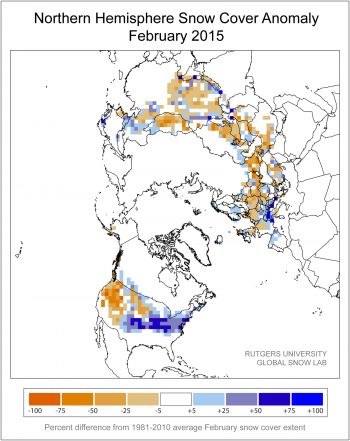
This unusual jet stream pattern is clearly manifested in the pattern of Northern hemisphere snow cover for February. Snow extent was well above average over the northeastern U.S. However, the western U.S. and Northern Rockies saw less snow cover than average, especially along the Pacific coast where it has been particularly warm and severely dry. While the Tibetan Plateau saw a somewhat more extensive snow cover than average in December and January, extent for Tibet and Eurasia as a whole was below average in February. Higher-than-average snow cover in the eastern U.S. expanded and became more pronounced this month as well. All of these are continuations of the basic pattern seen in December and January, although the pattern of extensive snow over the northeastern U.S. became more pronounced this month. The low snow cover extent in much of Eurasia is consistent with the warmer-than-average conditions there as described above.
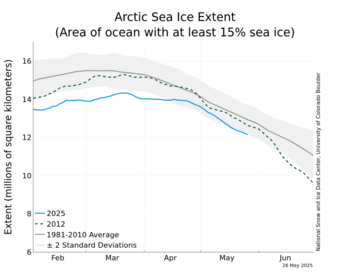
Incidentally, winter Arctic sea ice appears to have peaked earlier, and lower, than usual this year. Although winter ice extent is a poor predictor of what will happen during the summer melt, it is still interesting to compare this winter extent with that of 2012, the record breaking lowest-ice year in the Arctic.